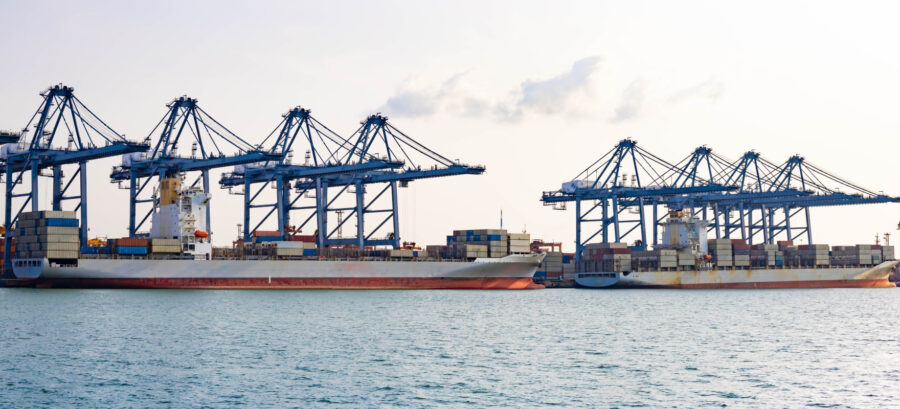
Egypt’s container port market entered 2026 from a significantly higher base. According to the Maritime Transport Sector of Egypt’s Ministry of Transport, Egyptian ports handled 11.1 million TEU in 2025, compared with 8.9 million TEU in 2024 — an increase of 24.3%. Vessel calls also reached a record 17,288, up 6.6% year on year.
Transit container traffic grew even faster. Egyptian ports handled 6.7 million TEU of transit containers in 2025, 36% more than in the previous year. This means that transit traffic represented around 60% of the country’s total container throughput.
For port operators, however, the important question is what exactly that cargo volume growth does to daily terminal operations.
More containers mean more vessel calls to coordinate, more yard moves to plan, more equipment tasks to distribute and more operational events to track. Growing transit flows add another level of time sensitivity because containers often need to connect with another vessel, transport leg or logistics corridor. At the same time, traffic patterns around the Suez Canal are changing again after a prolonged period of disruption.
For Egyptian terminals, this creates a particularly important operational challenge: capacity must not only grow — it must remain controllable while shipping patterns continue to change.
Egypt’s Container Traffic Has Reached a New Level
The scale of the 2025 increase is significant. Container throughput grew by almost a quarter in a single year, while transit traffic expanded even faster. The Ministry of Transport also reported that container-terminal productivity increased to 30,452 TEU per day in 2025, compared with 24,494 TEU per day in 2024.
This growth has taken place alongside a broader program of port and terminal development. Egypt has attracted a number of global terminal operators and shipping groups to new and expanded facilities, including projects involving CMA CGM, Hapag-Lloyd, Hutchison Ports, COSCO, MSC, Maersk and other international operators at Alexandria, Damietta, Dekheila, Sokhna, East Port Said and additional ports.
The result is a port system with more physical capacity, stronger liner connectivity and a growing role in regional transit flows.
East Port Said provides one visible example of this shift. In the World Bank and S&P Global Market Intelligence Container Port Performance Index for 2024, the port ranked third globally, reflecting strong vessel-processing performance.
But infrastructure development and high handling performance do not remove the operational challenge created by growth, raising the threshold instead. Once more cargo can physically enter the system, terminal operations must be able to plan, move and release it without allowing additional volume to create congestion elsewhere.
Transit Growth Changes the Operational Profile
The particularly rapid growth of transit containers deserves attention because transit traffic behaves differently from conventional import and export cargo.
For a domestic import, the terminal generally coordinates a journey from vessel discharge through storage, customs and eventual inland release.
A transit container may follow a very different route. In a direct transshipment scenario, it is discharged from one vessel, temporarily stored in the yard and loaded onto another service. The terminal therefore needs to preserve a connection between:
- the inbound vessel;
- the container’s yard location;
- the planned connecting service;
- loading cut-off times;
- equipment availability;
- the outbound vessel plan.
A wrong yard decision can translate into additional reshuffling. A late vessel may change the priority of hundreds of moves. A berth-plan change can affect yard workload and equipment allocation.
Transit growth therefore increases not only container volume but also the number of time-dependent relationships between operations, which becomes another dimension as well.
Egypt is also developing indirect transit between different ports and transport corridors. The Ministry of Transport specifically highlights the Alexandria–Sokhna logistics corridor as part of this model, connecting Mediterranean and Red Sea cargo flows through inland transport rather than direct vessel-to-vessel transshipment.
This means that transit growth can increase pressure not only on berth and yard operations, but also on gate capacity, rail coordination, truck planning and information exchange between different logistics nodes.
Suez Canal Traffic Is Beginning to Change Again
This growing port market is developing next to another changing part of the regional logistics system: the Suez Canal. After the severe disruption of Red Sea shipping routes, the first half of fiscal year 2025/26 brought signs of a gradual recovery. The Suez Canal Authority reported a 5.8% increase in transiting vessels, a 16% increase in net tonnage and an 18.5% increase in revenues compared with the same period of the previous fiscal year.
Developments during 2026 have provided further evidence that some container services are returning. In June, the 24,000-TEU CMA CGM VENDOME transited the Canal as part of an Asia–Europe service. One week later, the 24,212-TEU CMA CGM NOTRE DAME also passed through Suez.
By August, the Suez Canal Authority reported increasing activity from both CMA CGM and Maersk. On August 22, BANGKOK MAERSK, operating on the Asia–Europe AE7 service, made its first passage through the Canal, while the Authority said daily transits of Maersk-affiliated container vessels were increasing.
However, this does not mean that global shipping patterns have returned to a fixed pre-disruption model. On the contrary, the important operational lesson for terminals is that routing remains dynamic: services can return, frequencies can change, vessels can be reassigned and cargo can shift between alternative routes. For ports positioned around the Suez corridor, this means that flexibility becomes just as important as raw handling capacity.
More Containers Mean More Decisions
Terminal growth is sometimes described mainly through infrastructure: more quay length, more cranes, more yard area and higher annual capacity. All of these are essential, but every additional container also creates a sequence of operational decisions.
A terminal needs to determine:
- when and where the vessel will berth;
- which containers will be discharged first;
- where each container should be placed;
- which equipment will perform each move;
- which containers have tight connections;
- which yard blocks are approaching capacity;
- which trucks or trains are expected;
- which cargo can be released;
- which operational priorities have changed.
At low volumes, some inefficiencies can remain hidden: a container may require one unnecessary reshuffle, a truck may wait a little longer, and an equipment task may be assigned manually. In many cases, a dispatcher may resolve a conflict by phone.
When throughput increases by more than 20%, the same small inefficiencies begin to repeat at scale. The operational problem therefore grows faster than the container count itself.
Physical Capacity and Operational Capacity Are Not the Same Thing
A terminal may have the physical capacity to handle additional cargo while still struggling operationally, for example:
- A larger yard provides more storage space, but inefficient placement can consume that space surprisingly quickly.
- Additional cranes increase handling capability, but only if work is planned in a way that keeps equipment productive.
- New gates increase vehicle-processing capacity, but congestion can remain if trucks arrive unpredictably or cargo is not ready.
- A new berth creates opportunities for more vessel calls, but berth utilization depends on the interaction between vessel schedules, cargo readiness, yard pressure and available equipment.
This creates an important distinction: physical capacity describes how much infrastructure a terminal has, but operational capacity describes how effectively that infrastructure can be used.
Digital terminal management becomes particularly relevant at this point because the objective is no longer simply to automate individual tasks but to coordinate shared resources across multiple processes.
Five Areas That Come Under Pressure as Container Volumes Grow
1. Berth and Vessel Planning
As vessel traffic grows, berth windows become more tightly connected. A delay on one service may affect the next vessel, available quay cranes, yard workload and labour plans.
Terminal teams need an operational picture that combines vessel schedules, berth availability, cargo plans and handling resources so that changes can be evaluated before they propagate through the rest of the operation.
For transit-heavy terminals, vessel planning is even more sensitive because inbound and outbound services may be operationally linked through connecting containers.
2. Yard Planning
The yard is where many consequences of poor planning eventually become visible.
Containers need to be positioned according to factors such as:
- planned vessel;
- expected departure time;
- container type and size;
- weight;
- import, export or transit status;
- special handling requirements;
- available equipment;
- yard zoning rules.
If placement decisions consider only where free space exists now, the terminal may create unnecessary work later. As throughput increases, reducing rehandling becomes increasingly important because every additional reshuffle consumes equipment time without moving cargo closer to its destination.
3. Equipment and Workforce Allocation
Higher throughput creates more competing tasks.
Quay cranes, yard cranes, terminal tractors, reach stackers and other handling equipment cannot be everywhere at once. The same is true of operators and operational personnel. Resources need to be assigned according to current priorities rather than static plans.
A vessel operation may suddenly become urgent. A yard block may require additional equipment. A delayed truck flow may release capacity elsewhere. The larger the terminal becomes, the harder it is to coordinate these decisions through radio calls, spreadsheets or isolated workstations.
4. Gate and Hinterland Coordination
Container growth eventually reaches the landside interface.
For import and export traffic, higher port throughput usually means more truck visits, more gate transactions and more pressure on surrounding transport infrastructure. Indirect transit adds further complexity because cargo may need to move between marine terminals through road or rail corridors.
The operational objective becomes not simply to process each arriving vehicle quickly but to coordinate vehicle arrival with:
- cargo availability;
- customs or documentation status;
- yard readiness;
- equipment availability;
- loading or unloading capacity;
- planned time slots.
Otherwise, higher maritime throughput can simply move congestion from the berth to the gate.
5. Real-Time Operational Visibility
Growth also increases the number of people and systems that need current information.
- Planners need to know vessel status.
- Yard dispatchers need current cargo locations.
- Equipment operators need updated tasks.
- Gate teams need release information.
- Shipping lines need status messages.
- Management needs to understand bottlenecks and performance.
If each part of the operation works from a different version of the data, the terminal spends more time reconciling information precisely when operational pressure is increasing. Real-time visibility therefore becomes less of a reporting feature and more of a coordination mechanism.
Volume Is Only One Form of Pressure
The current Egyptian logistics environment highlights another point: terminal difficulty is determined not only by volume, but also by variability.
A terminal can prepare for predictable annual growth, but it is significantly harder to prepare for changing vessel schedules, route diversions, returning services, new shipping alliances, altered transit patterns and sudden differences in cargo mix.
This is particularly relevant around the Suez route. The terminal may need to operate efficiently under one traffic pattern today and a different one several months later. That places a premium on configurable operating rules and the ability to change priorities without rebuilding the entire operational process.
In other words, along with handling more containers, scalability becomes the ability to keep operations controlled when volume and operating conditions change at the same time.
What a Terminal Operating System Connects
A modern Terminal Operating System provides a common operational layer for planning and executing these interconnected processes. For a container terminal, this typically means connecting:
- vessel and berth operations;
- loading and discharge planning;
- container inventory;
- yard allocation;
- equipment tasks;
- truck and gate operations;
- rail workflows;
- container status and documentation;
- data exchange with shipping lines and other external systems;
- billing;
- operational KPIs and analytics.
The objective is to ensure that the same container, vessel, task and resource information is used throughout the operation. This is where digital terminal operations become a mechanism for scalability rather than simply an IT upgrade.
How Solvo.TOS Supports Growing Container Terminals
Solvo.TOS connects vessel, yard, gate, rail, truck, equipment and documentation processes within one terminal operating environment.
For container operations, the system maintains an operational record for each container throughout its movement between vessel, yard, rail and truck fronts. Placement rules can consider container parameters, yard topology, storage zones and planned operations, while vessel and landside workflows use the same current container locations and statuses.
The system can also support electronic data exchange with shipping lines and external platforms, operational tasks for field personnel, equipment integration, VGM control, empty-container processes and other container-specific workflows.
This shared operational environment becomes particularly important when throughput increases:
- More volume means more movements.
- More transit cargo means more dependencies between movements.
- Changing shipping patterns mean more frequent replanning.
A TOS helps terminal teams manage these changes as part of the same operational process rather than as a growing collection of manual exceptions.
From Infrastructure Growth to Operational Scalability
Egypt’s recent container-port performance shows that the country is not only expanding maritime infrastructure. Its role within regional container networks is also changing.
In 2025, container throughput increased by 24.3%, transit traffic grew by 36%, and vessel calls reached a record level. At the same time, 2026 has brought signs of renewed activity through the Suez Canal and the return of additional Asia–Europe container services.
For terminals, the next stage of growth therefore depends on more than additional physical capacity.
The challenge is to make sure that berths, yards, equipment, gates, inland transport and information flows can operate as one coordinated system as volumes and shipping patterns evolve.
Infrastructure determines how much cargo can be handled, while operational control determines how much cargo can be handled efficiently, predictably and at scale. As Egypt’s container market grows, that distinction becomes increasingly important.