

An ICD warehouse management system provides cargo-level control inside Inland Container Depots, dry ports and inland terminals where container operations and warehouse logistics meet.
Containers may arrive by rail or road, move through terminal storage and then enter a CFS warehouse for stripping. Export cargo can move in the opposite direction: individual cargo units arrive at the warehouse, are stored and consolidated, and later become part of a container.
A Terminal Operating System controls the terminal and container layer. Solvo.WMS for CFS & Terminal Warehouses manages the cargo-level warehouse processes between these transport stages.
What an ICD Warehouse Management System Controls
An ICD can include several operational environments within one logistics facility.
The terminal may contain:
- container yards;
- rail infrastructure;
- truck gates;
- warehouses;
- bonded storage;
- CFS stripping and stuffing areas.
Not every process belongs in the same software layer.
The warehouse management system is responsible for the cargo once it becomes a warehouse object.
This can include:
- receiving;
- identification and labeling;
- address-based storage;
- cargo inventory;
- operational status control;
- picking;
- staging;
- value-added services;
- consolidation;
- stuffing-related tasks;
- release.
Where WMS Fits in an Inland Terminal
Solvo.TOS and Solvo.WMS address different operational objects.
A TOS manages terminal operations around:
- containers;
- rail and road interfaces;
- terminal storage;
- equipment;
- yard movements;
- gate events.
The WMS focuses on the cargo inside the warehouse.
For example, a TOS may know that import container ABCD1234567 has reached the correct terminal location.
After stripping, the warehouse may instead need to control 25 pallets associated with several consignees, each stored in a different physical location.
At that point, warehouse execution requires cargo-level inventory.
See TOS and WMS Integration for CFS for the systems architecture.
Import Cargo at an ICD or Dry Port
Import containers can reach an ICD from a seaport or another transport hub.
Once a container enters CFS processing, the warehouse begins cargo-level operations.
Solvo.WMS can support:
- stripping-related receiving;
- cargo registration;
- Bill of Lading linkage;
- labeling;
- weight and dimension capture;
- temporary storage;
- customs-status control;
- delivery requests;
- picking;
- cargo release.
The original container can remain part of the terminal process while the WMS manages the individual cargo units created after stripping.
See the full CFS Import Process.
Export Cargo Consolidation at an Inland Terminal
Dry ports and ICDs can also serve as export consolidation points.
Cargo arrives from shippers before the container is ready for onward movement.
Solvo.WMS manages cargo during:
- receiving;
- inspection;
- temporary storage;
- consolidation;
- stuffing preparation.
The warehouse keeps each cargo unit linked to the relevant shipment information until loading is completed.
Once the container becomes ready for the next terminal operation, relevant information can be exchanged with the TOS.
Read more about the CFS Export Process.
LCL Operations at Inland Terminals
LCL cargo creates particularly strong demand for cargo-level warehouse control.
During import, one container may contain shipments for several different consignees.
During export, cargo from multiple shippers may need to be consolidated.
Solvo.WMS keeps individual cargo identifiable while its physical structure changes.
See LCL Cargo Consolidation and Deconsolidation.
Bonded and Temporary Storage
Many inland terminal operations also involve cargo that cannot yet be released.
Solvo.WMS can maintain customs-related operational statuses received from external systems and apply them during warehouse execution.
Cargo can remain physically stored in a known warehouse location while dispatch remains restricted.
Once the required status is received, the cargo can proceed according to the configured warehouse process.
Learn more in Bonded Warehouse Management.
Truck Appointment and Gate Coordination
An ICD normally combines warehouse processes with intensive road flows.
Import consignees arrive to collect cargo, while export shippers deliver new cargo to the warehouse.
When vehicle arrivals are not coordinated with warehouse capacity, congestion can quickly move from the gate into the CFS process.
Time-slot management allows visits to be planned in advance, while Solvo.WMS connects the visit with cargo readiness or receiving work.
For broader vehicle and yard orchestration, Solvo.YMS can manage checkpoints, waiting areas and internal vehicle movements.
See Truck Appointment System for CFS for the CFS-specific workflow.
Integrating TOS, WMS and YMS at a Dry Port
A dry port does not need one oversized system to control every process.
A modular operating model can separate responsibilities:
Solvo.TOS
Container, rail, road, terminal and yard-related terminal processes.Solvo.WMS
Cargo receiving, storage, inventory, warehouse tasks, consolidation and release.Solvo.YMS
Vehicle appointments, gate processes, waiting areas and yard movements where a dedicated yard layer is required.Solvo.Web
Customer-facing requests and cargo information.Solvo.Billing
Commercial accounting for configured services.
The systems exchange relevant information while maintaining a clear operational boundary.
For the terminal side of this architecture, see Solvo.TOS for Inland Terminal Operations.
Value-Added Services at Inland Logistics Hubs
An ICD warehouse can also provide additional cargo services.
Depending on the facility, these may include:
- weighing;
- labeling;
- inspection;
- repacking;
- palletization;
- photo capture;
- temporary storage;
- special handling.
Solvo.WMS records these operations within cargo execution, while Solvo.Billing can support their commercial accounting.
This allows an inland logistics hub to develop additional services without losing the connection between cargo, customer and performed work.
A Cargo-Level Warehouse Layer for Inland Terminals
Solvo.WMS is designed for inland facilities that need more cargo-level control than a TOS alone provides, but do not want to treat every CFS process as a conventional retail distribution center.
The system supports two fundamental warehouse flows:
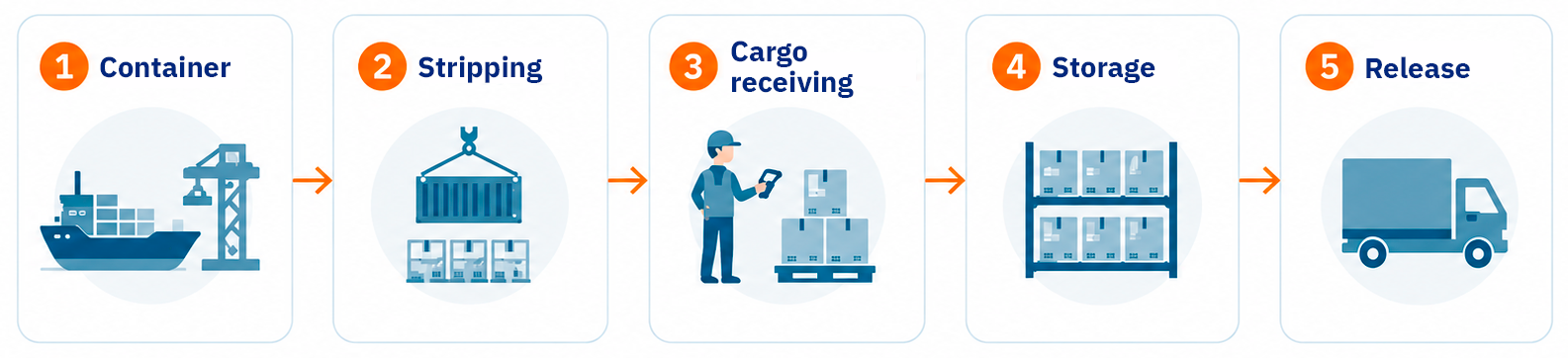
and:
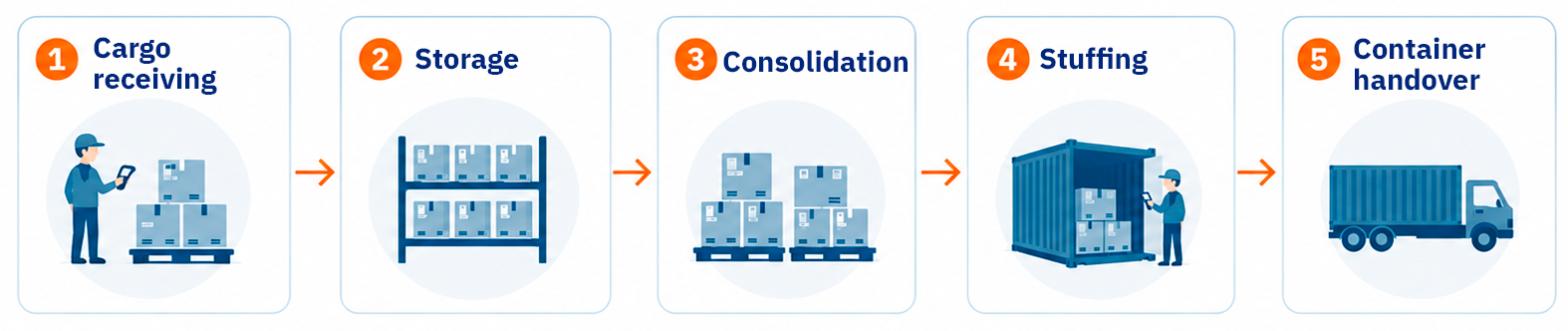
This creates a dedicated warehouse layer between intermodal terminal operations and individual cargo handling.
Frequently Asked Questions
What is an ICD warehouse management system?
It is a WMS used to control cargo-level warehouse operations inside an Inland Container Depot, including receiving, storage, inventory, status control, picking, services, consolidation and release.
What is the difference between an ICD TOS and WMS?
A TOS manages container, rail, road and terminal processes. A WMS manages the individual cargo units handled inside the warehouse or CFS area.
Can the same WMS support import and export operations?
Yes. Import warehouse processes move from container to cargo, while export processes move from cargo toward consolidation and container stuffing.
Can Solvo.WMS support bonded warehouse operations at a dry port?
Solvo.WMS can use customs-related statuses received from external systems and restrict warehouse dispatch until the required release condition is confirmed.
Connect Your Dry Port with Cargo-Level Warehouse Control
Use Solvo.WMS between container terminal operations and individual cargo receiving, storage, consolidation and release.