

The CFS export process turns individual cargo units into a container-ready shipment. Unlike an import operation, where one container becomes many cargo units, export CFS operations work in the opposite direction: cargo arrives from shippers, is received and stored, consolidated according to shipment requirements and prepared for container stuffing.
During this process, the warehouse must know what cargo has arrived, which booking or shipment it belongs to, where it is stored, whether the required checks are complete and what should be loaded into the container.
Solvo.WMS for CFS & Terminal Warehouses provides the cargo-level control required before the shipment returns to the container-level terminal process.
How the CFS Export Process Works
A typical export workflow can be represented as:
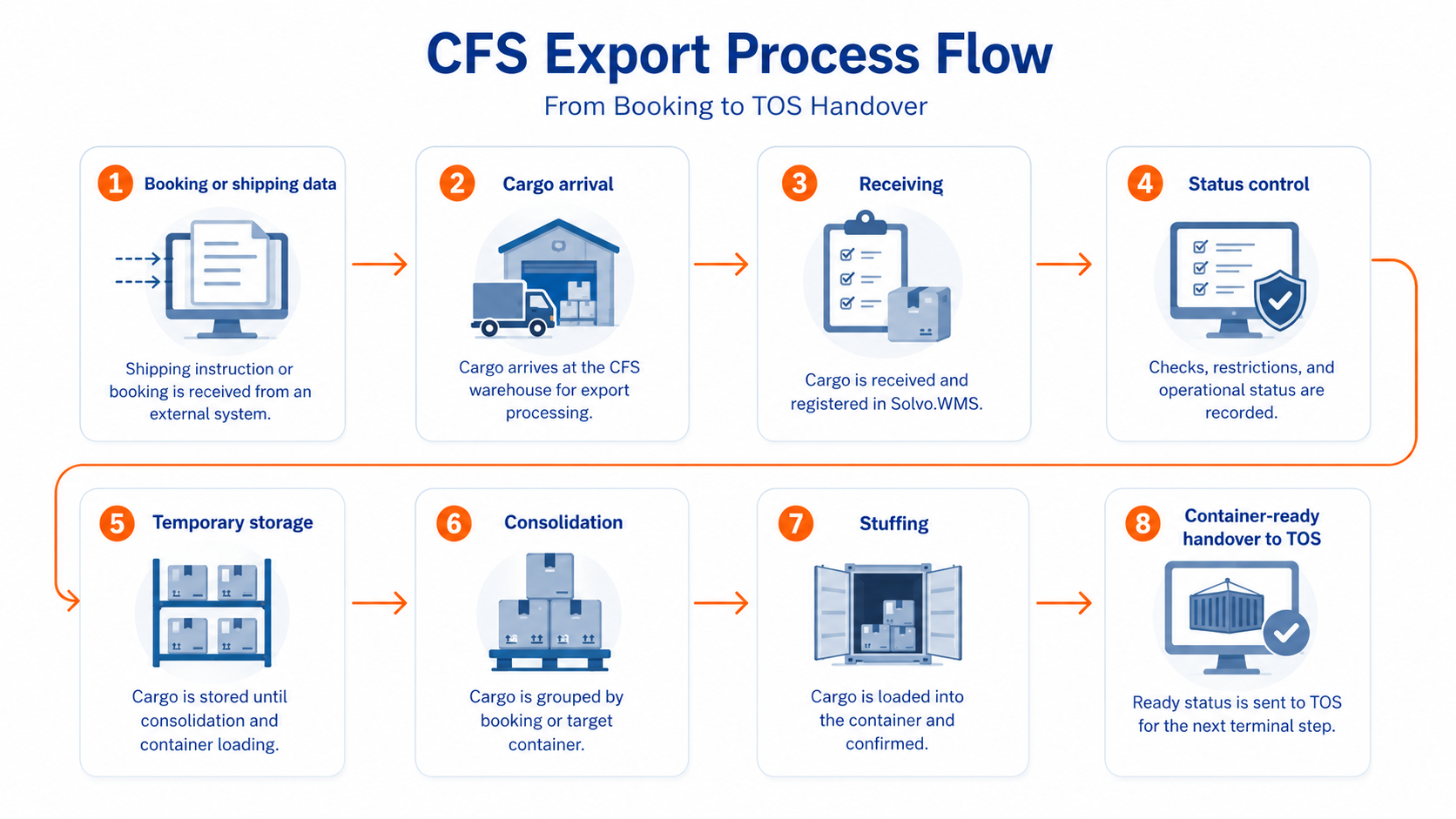
The WMS keeps cargo identifiable throughout this process, even when shipments arrive at different times or require additional handling before consolidation.
Receiving Export Cargo at the CFS
Export cargo can arrive at the warehouse from multiple shippers or other logistics facilities.
Shipment, booking or document information can be received from ERP, TOS or another connected system. Depending on the project, this data can be available before the physical cargo arrives.
Warehouse personnel then register the actual cargo using mobile devices.
Receiving may include:
- cargo identification;
- shipment or document linkage;
- label printing;
- weight and dimension capture;
- status assignment;
- damage or discrepancy registration;
- photo capture;
- confirmation of the received handling units.
This creates a digital cargo record that remains available until stuffing is completed.
Export Documentation and Cargo Status Control
Some export processes require additional documents, certificates or external statuses before cargo can proceed.
This can be particularly important for agricultural products, animal-origin goods, food, temperature-sensitive cargo or other regulated exports.
Solvo.WMS can maintain the relevant operational status together with the cargo record and use it during warehouse execution. When a required status or check is incomplete, the cargo can remain restricted from the next operation.
The WMS does not replace customs, certification or regulatory systems. Instead, it receives or records the information needed to enforce warehouse rules.
For customs-controlled scenarios, see Bonded Warehouse Management.
Temporary Storage Before Consolidation
Export cargo does not necessarily move directly from the inbound truck into a container.
Different shipments may arrive at different times. The CFS may also be waiting for additional cargo, documentation, instructions or container availability.
During this period, Solvo.WMS manages cargo through address-based storage.
The system retains the relationship between cargo and relevant information such as owner, shipment, booking, status and warehouse location.
Configurable putaway rules help determine where cargo should be stored based on operational requirements and the expected next step.
Export Cargo Consolidation
Once the required cargo is available, the warehouse can begin consolidation.
Solvo.WMS helps identify the cargo required for the planned shipment and creates tasks for warehouse personnel to retrieve it from storage.
Warehouse execution can include:
- selecting the required cargo units;
- moving them to a consolidation or stuffing area;
- scanning cargo during movement;
- confirming each completed task;
- retaining the connection between physical cargo and shipment data.
This is especially important for LCL operations, where cargo from multiple shippers or shipments is handled within one warehouse.
Read more about LCL Cargo Consolidation.
Container Stuffing and Loading Confirmation
During stuffing, the selected cargo is loaded into the assigned container.
Solvo.WMS supports warehouse execution around this process by controlling cargo preparation, movement tasks and operation confirmation.
The system can help ensure that the warehouse knows:
- which cargo was prepared for loading;
- which cargo units entered the stuffing process;
- which container is involved;
- whether required warehouse tasks have been completed.
Solvo.WMS should not be positioned as an automatic 3D container load optimizer unless this functionality is included in a specific project. Its role is to provide operational control around cargo preparation and stuffing execution.
Handover from WMS to TOS
Once stuffing-related warehouse work is complete, the operational focus moves back from cargo to the container.
The container can then enter the next terminal process.
Integration between Solvo.WMS and TOS allows the systems to exchange the relevant completion and readiness information without forcing either system to take over the other’s responsibilities.
The WMS manages cargo-level warehouse execution. The TOS manages the container and its subsequent terminal movements.
See TOS and WMS Integration for CFS for more detail.
Managing Temperature-Sensitive and Regulated Export Cargo
Some CFS export operations need additional warehouse controls.
Solvo.WMS can support scenarios involving:
- chilled and frozen storage zones;
- batch and pallet-level stock;
- FEFO-based allocation;
- weight-based inventory;
- document or certificate statuses;
- dispatch restrictions when required checks are incomplete.
These capabilities can be particularly relevant to food, agricultural and animal-origin exports.
For broader warehouse functionality for temperature-sensitive goods, see Food & Beverage WMS.
Value-Added Services Before Export
Export cargo can require additional preparation before stuffing.
Depending on the operation, these services can include:
- labeling;
- repacking;
- palletization;
- weighing;
- inspection;
- photo capture;
- special handling.
When these activities are recorded as part of warehouse execution, they can also be connected with service accounting through Solvo.Billing.
See CFS Billing and Value-Added Services.
How Solvo.WMS Supports the CFS Export Process
Solvo.WMS provides a cargo-level execution environment before the cargo becomes part of a container.
The system connects:
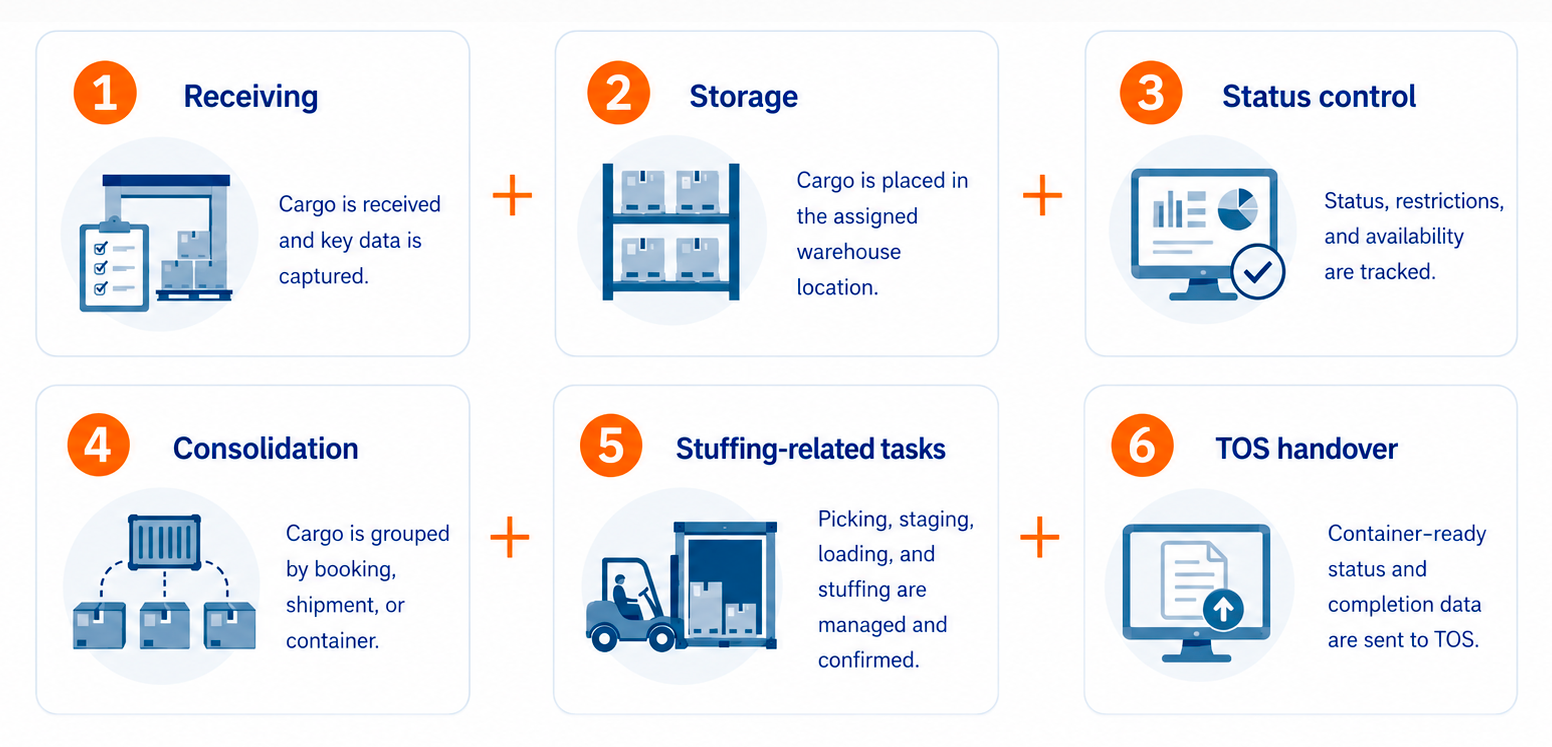
This gives terminal warehouse teams visibility and control over export cargo from arrival at the CFS to container readiness.
Frequently Asked Questions
What is the CFS export process?
A typical CFS export process includes cargo receiving, inspection and status control, temporary storage, consolidation, stuffing and handover of the loaded container to the terminal process.
How is export cargo consolidated in a CFS?
Cargo remains identifiable while in storage. Once the required shipment is ready, warehouse tasks can retrieve selected cargo units and move them to the consolidation or stuffing area.
Does Solvo.WMS manage container stuffing?
Solvo.WMS supports warehouse execution around stuffing, including cargo preparation, movement tasks and loading confirmation. Container terminal operations remain within the TOS layer.
Can export document status affect warehouse operations?
Yes. Relevant external statuses can be connected with cargo records and used as conditions before cargo proceeds to the next warehouse operation.
Control Export Cargo Before It Becomes a Container
Manage receiving, temporary storage, consolidation and stuffing-related operations in one cargo-level environment.