

TOS and WMS integration connects two different operational levels of a Container Freight Station. A Terminal Operating System manages terminal and container processes, while a Warehouse Management System controls the individual cargo units handled inside the CFS warehouse.
A CFS may need both.
During import, one container in the TOS can become dozens of cargo units in the WMS after stripping. During export, the process runs in reverse: separately received cargo is consolidated and eventually becomes a container that returns to the terminal workflow.
Solvo.WMS provides the cargo-level warehouse layer while integration preserves continuity between these processes.
Why TOS and WMS Integration Matters for CFS
A container and the cargo inside it are not the same operational object.
Before stripping, the terminal needs to know where the container is and what should happen to it.
After stripping, the warehouse needs to know where every pallet or carton is, who it belongs to, what status it has and whether it can be released.
Trying to force both levels into one operational model can create gaps or excessive complexity.
A clearer architecture assigns each system responsibility for the process it is designed to manage.
What a TOS Manages
A TOS is focused on terminal operations.
Depending on terminal type and configuration, this can include:
- container arrival;
- vessel operations;
- terminal yard movements;
- container storage;
- rail operations;
- equipment tasks;
- gate events;
- container availability and status.
Solvo.TOS supports these terminal-level processes across marine and inland terminal environments.
What a WMS Manages
Solvo.WMS for CFS & Terminal Warehouses focuses on the warehouse layer.
This includes processes such as:
- cargo receiving;
- identification and labeling;
- storage allocation;
- warehouse movements;
- cargo-level inventory;
- picking and staging;
- value-added services;
- delivery requests;
- cargo release;
- export consolidation;
- stuffing-related warehouse tasks.
The WMS therefore manages the cargo after it becomes a warehouse object.
Import Integration: From Container to Cargo
During import, a TOS or another external system can provide the information required for the CFS to start cargo-level processing.
Once the container is available for stripping, warehouse operations begin in Solvo.WMS.
The WMS then manages:
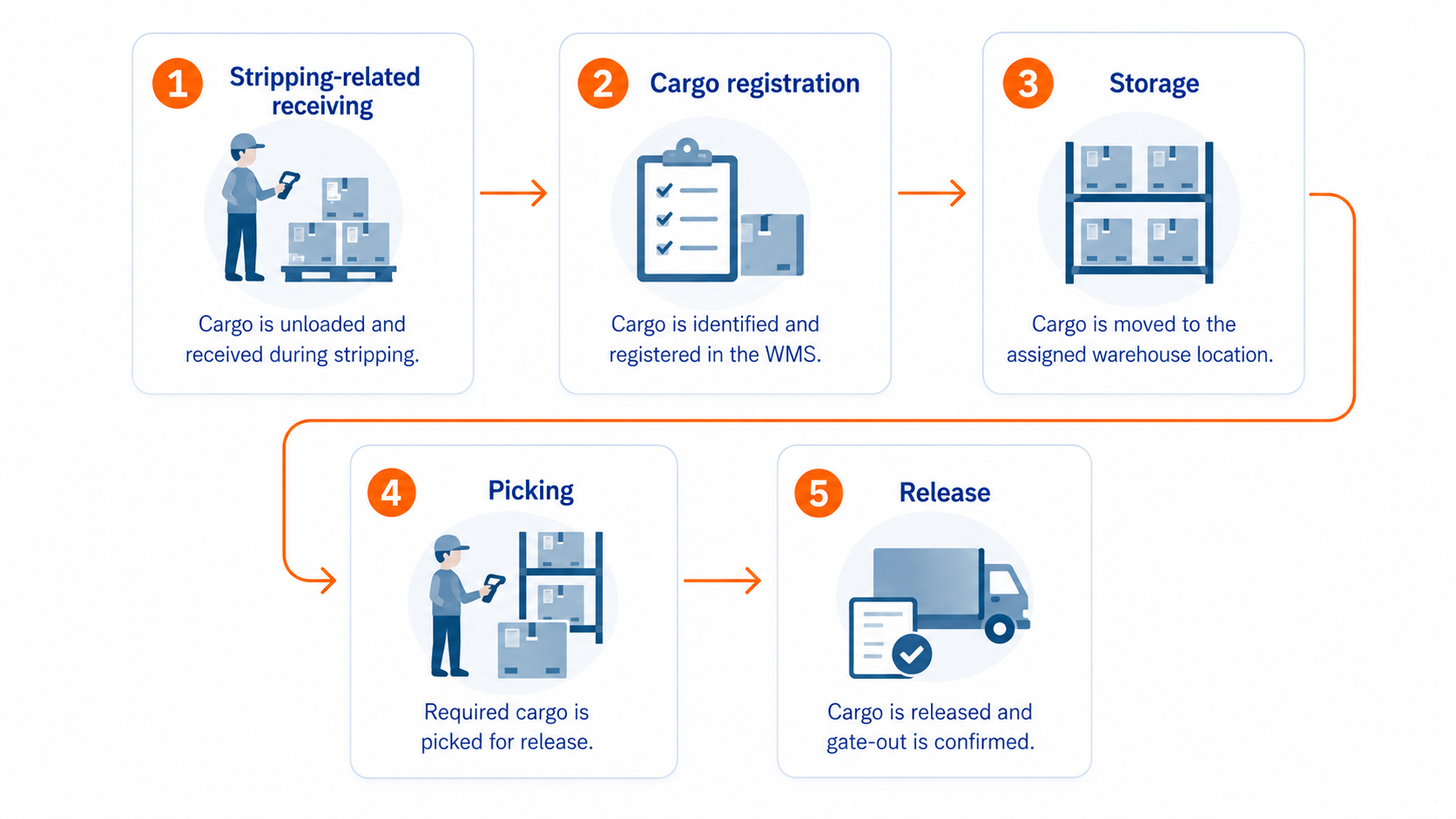
When the relevant warehouse operation is completed, status information can be returned to the terminal environment.
See the complete CFS Import Process.
Export Integration: From Cargo to Container
For export, the WMS becomes involved before the cargo is loaded into a container.
Cargo can arrive from multiple shippers and remain under warehouse control during:
- receiving;
- inspection;
- temporary storage;
- consolidation;
- stuffing preparation.
Once stuffing-related work is complete, the process returns to the container level.
Relevant readiness or completion information can then be exchanged with the TOS for the next terminal operation.
Read more about the CFS Export Process.
Container Availability and Readiness
Integration is particularly important at the handover points between the systems.
Depending on project requirements, relevant information can include:
- container number;
- container availability;
- readiness for warehouse processing;
- stripping completion;
- stuffing completion;
- readiness for subsequent terminal handling.
For refrigerated export cargo, integration can also include project-specific information related to container readiness, such as required pre-cooling status.
ERP Integration
CFS processes also depend on commercial and document data outside the TOS.
ERP can provide information required for warehouse operations, such as:
- orders;
- cargo information;
- customer data;
- shipment-related documents;
- commercial references.
Solvo.WMS can return execution information after warehouse operations are completed.
This helps reduce manual data transfer between commercial and operational systems.
EDI / EDIFACT and Integration Middleware
Different terminals already have different integration landscapes.
Solvo.WMS supports integration through REST API and messaging or event-based architectures. The platform can work with middleware such as RabbitMQ or Kafka and supports EDI / EDIFACT data-exchange scenarios where required.
This allows the integration model to be adapted to the customer’s IT architecture rather than requiring every CFS to replace its existing systems.
Gate and Yard Integration
Cargo readiness and truck movement are also closely connected.
A warehouse may finish preparing cargo before the truck arrives, while a yard or gate system controls the vehicle’s physical movement outside the warehouse.
Solvo.WMS can therefore operate alongside gate technologies and Solvo.YMS.
For the CFS-specific appointment process, see Truck Appointments & Gate.
One Connected Environment, Clear System Responsibilities
A connected CFS architecture does not mean one system must control every logistics process.
A clearer model is:
TOS — terminal and container operations
WMS — cargo and warehouse execution
ERP — commercial and enterprise data
YMS / Gate — vehicle and yard processes
Solvo.Billing — service accounting
Solvo.Web — customer requests and visibility
Integration allows each system to use relevant information from the others while maintaining a clear operational role.
Frequently Asked Questions
What is the difference between TOS and WMS?
A TOS manages terminal-level processes such as containers, vessels, yards and terminal movements. A WMS manages cargo-level warehouse processes such as receiving, storage, picking, consolidation and release.
Why does a CFS need TOS and WMS integration?
After stripping, one container can become many independently handled cargo units. During export, many cargo units can become one container. Integration supports the handover between these two operational levels.
What information can TOS and WMS exchange?
Project-specific data can include container number, availability, readiness, stripping or stuffing completion and shipment-related information required for warehouse execution.
Can Solvo.WMS integrate with third-party TOS platforms?
Solvo.WMS supports integration with external systems through configurable interfaces and integration architectures selected for the customer’s IT environment.
Connect Container and Cargo-Level Operations
See how Solvo.WMS can work with your TOS, ERP, gate systems and other terminal technologies without duplicating their responsibilities.