
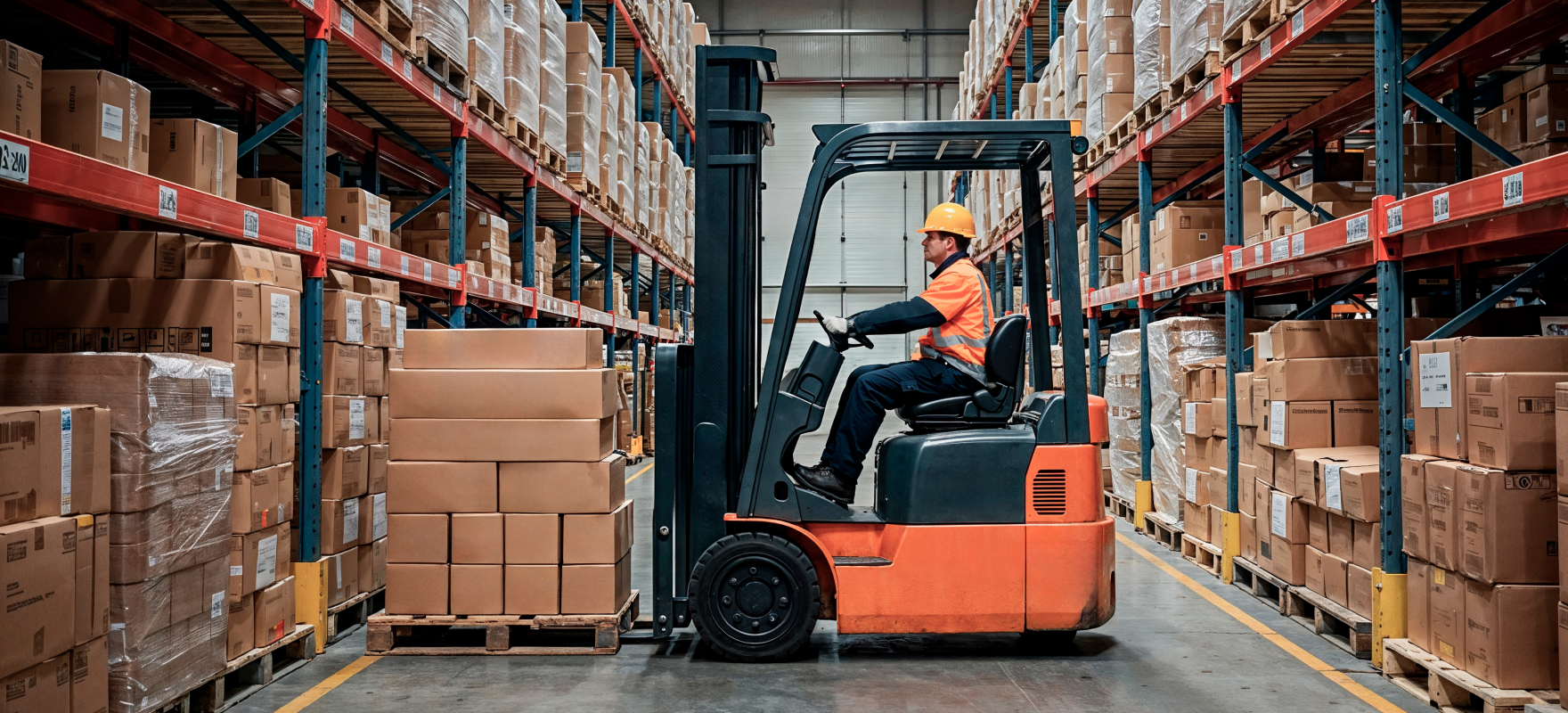
Cargo release is often treated as the final step of a CFS operation. In practice, however, delays at the loading dock usually begin much earlier.
A truck may wait because cargo was stored without a clearly registered location. A warehouse team may start preparing a shipment only after the driver arrives. Employees may need to check customs status manually, search for individual pallets or confirm release details through calls and spreadsheets.
None of these problems start at the gate.
They are the result of decisions made throughout the cargo journey — from receiving and storage to picking, staging and dispatch.
Improving CFS performance therefore requires more than speeding up individual warehouse operations. The entire release process must become planned, visible and system-driven.
Cargo Release Starts Before the Truck Arrives
A predictable dispatch process depends on several events being synchronized:
- the cargo has been identified and located;
- all required documentation and release conditions have been fulfilled;
- the warehouse knows when the cargo will be collected;
- picking and staging tasks have been completed;
- the loading area has sufficient capacity;
- the truck arrives when both cargo and warehouse resources are ready.
If these events are managed separately, the loading dock becomes the place where earlier coordination problems finally become visible.
Warehouse staff search for cargo while trucks wait. Dispatch employees make calls to clarify readiness. Consignees request status updates. Forklift operators are redirected from planned tasks to urgent searches.
The better approach is to connect cargo preparation with the expected pick-up event before the vehicle reaches the terminal.
Replace Manual Cargo Search with Directed Storage
One of the simplest sources of CFS inefficiency is also one of the most persistent: employees know that cargo is somewhere in the warehouse, but not exactly where. This is particularly difficult in operations where one stripped container creates dozens or hundreds of individual handling units.
If pallets, cartons or other cargo units are moved without systematic location registration, every later operation becomes dependent on individual employee knowledge.
A warehouse management system changes this process by connecting cargo identification with address-based storage.
When cargo is received, the system can:
- register the cargo unit;
- assign or print an identification label;
- select an appropriate storage location according to predefined rules;
- issue a put-away task to the operator;
- confirm the final location through scanning.
The result is not simply a more accurate stock record. Factually, the next employee does not need to know where a colleague decided to place the cargo since the system already knows.
This becomes especially valuable during release, when warehouse teams must prepare multiple shipments within a limited time window.
Turn Warehouse Execution into a System-Guided Process
CFS operations often depend heavily on experienced employees who know where cargo is usually placed, which shipments are urgent and how different customers prefer their cargo to be handled. That experience is valuable. However, it should not be the only thing keeping the process under control.
System-guided warehouse execution turns operational rules into tasks. Instead of deciding independently what to do next, operators and forklift drivers receive instructions through mobile terminals. Depending on the workflow, these tasks may cover:
- receiving;
- put-away;
- internal movements;
- picking;
- staging;
- consolidation;
- stuffing preparation;
- dispatch.
Each task can include the cargo unit, source and destination location, required operation and confirmation step. Barcode scanning or other identification methods then allow the system to verify that the correct cargo is being handled in the correct location.
This reduces the number of manual decisions required on the warehouse floor and makes execution more consistent across employees and shifts.
Coordinate Truck Arrivals with Cargo Readiness
Truck scheduling alone does not solve congestion. A time slot is useful only if it is connected to the warehouse operation that must happen before the truck arrives.
A more coordinated CFS workflow can link a pick-up request with a planned truck visit and following cargo preparation, staging and dispatch. Once a delivery or pick-up request is registered, the warehouse knows which cargo will be required and when.
Tasks can then be prioritized according to the planned release time. Cargo can be picked and staged in advance, while available dock and warehouse capacity can be considered when planning the truck visit.
This creates a much more predictable sequence:
- the warehouse knows what must be prepared;
- the dispatch team knows when it will be required;
- the consignee receives a clearer status;
- the truck arrives when the operation is ready.
Instead of using the gate as the trigger for cargo preparation, the terminal uses the expected truck arrival as a planning input.
Make Export Consolidation More Reliable
Import release is only one side of CFS operations. Export cargo creates a different coordination challenge.
Multiple shipments may arrive separately and later need to be consolidated into the correct container according to booking, customer and documentation requirements.
If consolidation relies heavily on manual checks, growing export volumes can increase the risk of:
- cargo being assigned to the wrong booking;
- incorrect stuffing sequences;
- missing cargo;
- unnecessary internal movements;
- last-minute corrections before container closure.
A system-driven process can connect received cargo with the corresponding booking and create consolidation and stuffing tasks according to defined rules.
This gives the warehouse a clear understanding of what belongs to this container, where it is now, and what should be moved next. The objective is to make preparation repeatable and traceable before physical loading begins.
Use Storage Rules Instead of Free-Space Decisions
In a CFS warehouse, storage decisions may need to consider far more than whether a location is empty.
Depending on the cargo and business process, relevant parameters may include:
- cargo owner;
- Bill of Lading;
- booking;
- cargo category;
- dimensions and weight;
- storage conditions;
- expected storage duration;
- planned release date;
- dispatch priority;
- compatibility with nearby cargo;
- warehouse zone and equipment accessibility.
Rule-based storage allocation allows these factors to become part of the operational logic.
For example, cargo expected to leave soon can be placed in a location that minimizes future movements, while long-term storage can be assigned to less accessible areas.
This improves space utilization without treating warehouse capacity as a simple percentage of occupied locations. The real objective is to use space in a way that supports future operations.
Reduce Dependency on Individual Employee Experience
CFS workloads can change quickly. Seasonal peaks, new contracts and growing cargo volumes may require additional warehouse personnel. Yet training new employees becomes difficult when operational knowledge exists mainly in the heads of experienced staff.
System-generated mobile tasks help separate warehouse execution from individual memory. A new operator does not need to learn every location, customer rule or process exception before becoming useful.
The system can provide:
- the next operation;
- the cargo to be handled;
- the source location;
- the destination;
- required confirmations;
- task sequence and priority.
Experienced employees remain essential for exceptions, supervision and process improvement, but routine execution becomes easier to standardize.
This also changes how the organization uses expertise: experienced staff can spend less time explaining repetitive operations and more time solving non-standard cases and optimizing the process.
Improve Visibility for Customers and Dispatch Teams
Operational inefficiency is not limited to physical cargo handling. When customers repeatedly call or email to ask whether cargo has arrived, cleared or become available for collection, warehouse information becomes a communication workload.
The same happens internally when dispatch teams cannot see the current preparation status without contacting warehouse personnel.
Integrations with TOS, ERP and customer-facing systems can reduce this manual exchange. When cargo status is updated as part of the operational workflow, the same information can be made available to other systems and users.
This gives customers better visibility while allowing warehouse and dispatch teams to spend less time reconstructing information that already exists somewhere in the operation.
How Solvo.WMS Supports CFS Execution
Solvo.WMS for CFS and terminal warehouses provides warehouse-level execution within a broader terminal environment.
Depending on the project configuration, the system can support:
- cargo-unit registration and labeling;
- address-based and rule-based storage;
- system-generated mobile tasks;
- picking and staging;
- booking-based consolidation;
- container stuffing preparation;
- delivery and pick-up requests;
- truck time-slot planning;
- customs and documentation status control;
- dispatch blocking;
- operational KPI monitoring;
- integration with TOS, ERP and external systems.
This allows the terminal to maintain cargo-level control without separating warehouse execution from the rest of the logistics chain.