

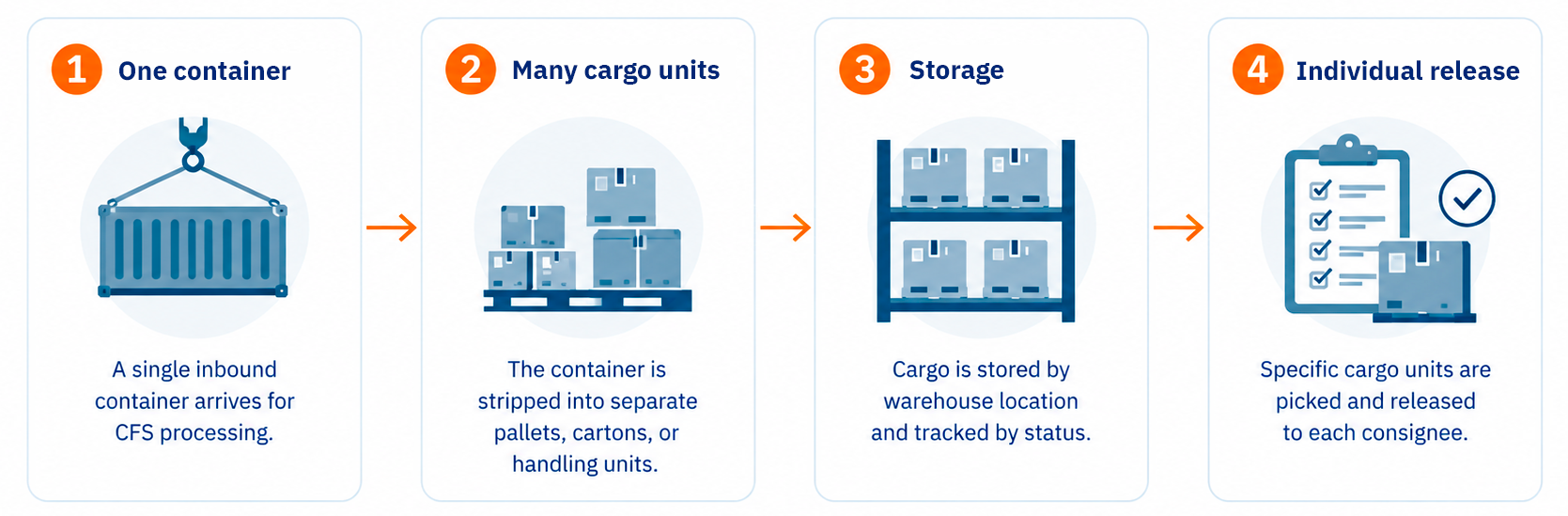
LCL cargo consolidation requires a Container Freight Station to control individual shipments before they become part of one container. LCL deconsolidation creates the opposite challenge: one import container is stripped into multiple cargo units that may belong to different owners and consignees.
Both processes require more detailed control than the original container record can provide.
Solvo.WMS for CFS & Terminal Warehouses maintains cargo-level visibility across receiving, deconsolidation, storage, consolidation, partial release and stuffing-related warehouse operations.
How LCL Cargo Consolidation Works
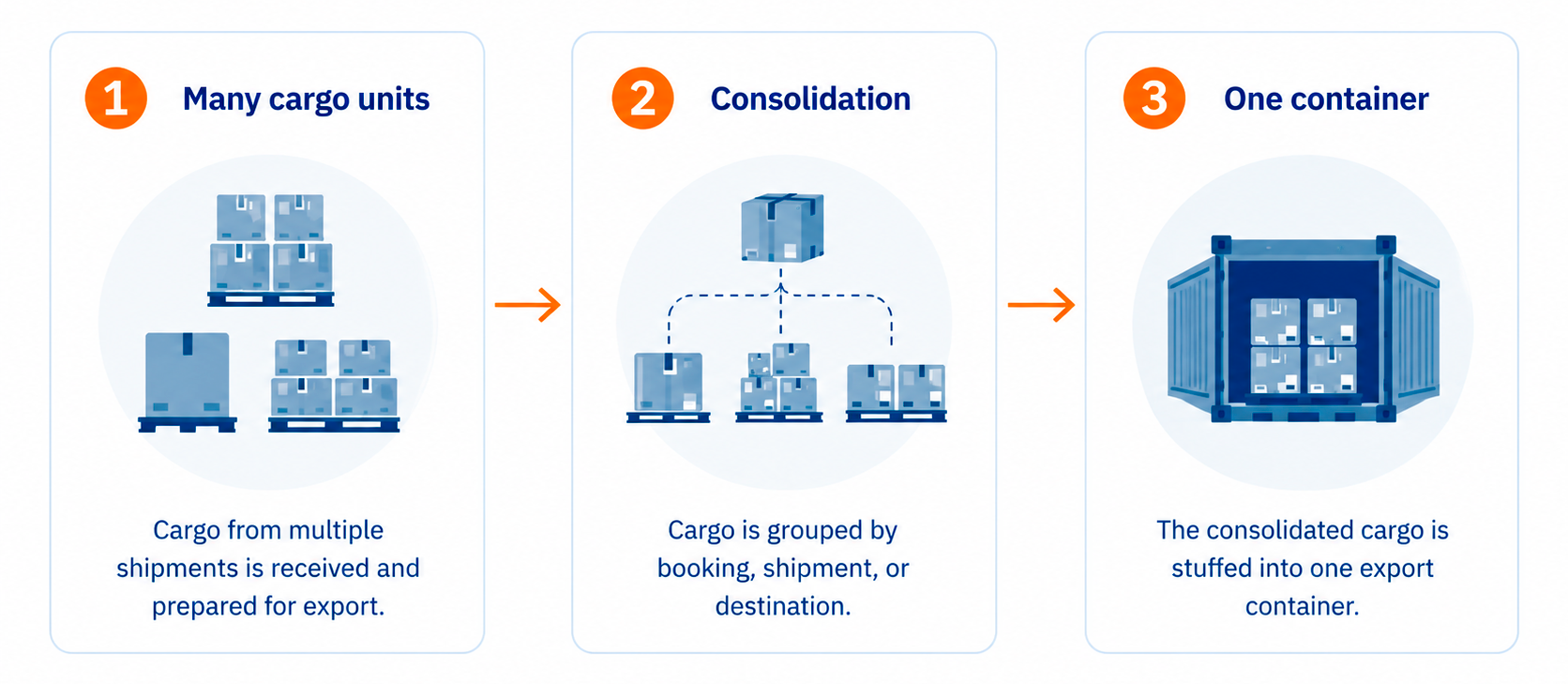
During export, cargo from different shipments can arrive at the CFS at different times.
Each cargo unit must remain identifiable while the warehouse waits for the rest of the shipment or other conditions required for consolidation.
Solvo.WMS can maintain information such as:
- cargo owner;
- consignee;
- booking;
- shipment-related document;
- handling unit;
- warehouse location;
- status;
- weight and dimensions;
- operation history.
Once the required cargo is available, the WMS can generate tasks to retrieve it from storage and move it to a consolidation or stuffing area.
This creates a controlled cargo-to-container flow instead of relying on manual searches or employee memory.
For the complete outbound workflow, see the CFS Export Process.
What Is LCL Deconsolidation?
Import LCL operations work in the opposite direction.
A consolidated container may contain cargo associated with several Bills of Lading, cargo owners or consignees.
After stripping, the warehouse needs to separate and identify the cargo correctly.
The receiving process can capture:
- cargo identifiers;
- Bill of Lading;
- owner and consignee;
- handling unit;
- quantity;
- weight;
- dimensions;
- condition;
- warehouse status.
The cargo can then be assigned to individual storage locations while remaining linked to the relevant shipment information.
See CFS Import Operations for the full container-to-cargo process.
Why Container-Level Visibility Is Not Enough for LCL
A terminal may know exactly where a container is located and still be unable to answer a simple customer question after stripping:
Where is my cargo?
The original container may already be empty while individual pallets or cartons remain in different warehouse locations.
The CFS needs to know:
- where each cargo unit is stored;
- which consignee it belongs to;
- whether the expected quantity was received;
- whether damage was recorded;
- whether it is available for release;
- which services have been performed;
- whether part of the shipment has already left.
Solvo.WMS maintains the cargo record after the original container has stopped being the primary unit of control.
This is the key difference between container visibility and true cargo-level visibility.
Managing Different and Mixed Handling Units
LCL operations rarely involve one uniform cargo structure.
A terminal warehouse may receive:
- full pallets;
- partial pallets;
- cartons;
- boxes;
- mixed handling units;
- other packaged cargo.
Depending on the warehouse process, cargo can also be divided, combined or partially released while its relevant document and ownership relationships remain available in the WMS.
This flexibility is particularly useful when the physical handling unit changes during repacking or consolidation.
Address-Based Storage for LCL Cargo
After deconsolidation, cargo for many different customers may share the same warehouse.
A general location such as “Warehouse A” is therefore not enough.
Solvo.WMS supports address-based storage and records the exact warehouse location of each cargo unit.
Putaway strategies can also consider parameters such as:
- cargo owner;
- consignee;
- Bill of Lading;
- cargo type;
- storage requirements;
- expected duration;
- planned release timing.
Warehouse personnel receive system-generated movement tasks and confirm operations using mobile devices.
For a deeper view of this functionality, see CFS Inventory Management.
Partial Cargo Release
LCL shipments do not necessarily leave the warehouse as one complete unit.
Selected cargo can be released while other cargo remains in storage.
A delivery request identifies what should be dispatched. Solvo.WMS can then generate picking and staging tasks for the required cargo units while preserving the current location and status of everything that remains.
This allows one warehouse to support multiple owners, consignees and release events without losing cargo-level traceability.
Coordinating LCL Release with Truck Visits
When many consignees collect cargo independently, truck arrival planning becomes part of the LCL process.
Without scheduling, several customers may arrive simultaneously while staff are still locating cargo.
Delivery requests and time slots allow the warehouse to prepare selected cargo in advance and coordinate pick-up with operational capacity.
Read more about Truck Appointments for CFS.
Value-Added Services for LCL Cargo
Individual LCL shipments can require services that would not necessarily be performed on an intact container.
These may include:
- labeling;
- repacking;
- palletization;
- weighing;
- inspection;
- photo capture;
- special handling;
- temporary storage.
Solvo.WMS records these activities as cargo operations. When services are chargeable, relevant operational data can be used by Solvo.Billing.
See CFS Billing and Value-Added Services.
Cargo-Level Control as Shipment Structure Changes
LCL operations constantly change the physical structure of a shipment.
During import:
During export:
Solvo.WMS provides the warehouse layer required to keep each cargo unit identifiable throughout these transformations.
Frequently Asked Questions
What is LCL cargo consolidation?
LCL consolidation combines cargo from multiple shipments into a consolidated container while maintaining information about the individual shipments and cargo units before loading.
What is LCL deconsolidation?
LCL deconsolidation is the reverse process. A consolidated import container is stripped and its cargo is separated, identified, received and prepared for storage or release.
Why is a WMS useful for LCL operations?
After stripping, one container can become many pallets, cartons or other cargo units. A WMS keeps track of their individual locations, owners, documents, statuses and warehouse operations.
Can Solvo.WMS support partial cargo release?
Yes. Selected cargo units can be picked and released while other cargo remains under warehouse control, depending on the configured process.
Manage LCL Cargo at Cargo Level
Maintain control from import deconsolidation to consignee release — and from export cargo receiving to consolidation and stuffing.