Portugal as an Atlantic gateway with Mediterranean relevance
Despite not being a Mediterranean country geographically, in logistics terms, Portugal is closely connected to the Mediterranean conversation. The country sits at the intersection of Atlantic routes, European supply chains, African trade links and wider Mediterranean flows. For ports and terminals, this means operating in an environment where different transport modes, cargo types and trade patterns meet — often within the same port system.
That makes Portugal a strong example of a broader regional reality: port operations are becoming structurally complex, not simply busy.
The Mediterranean itself remains one of the world’s most strategically important logistics regions. The Suez route, which connects the Mediterranean Sea with the Red Sea, handled approximately 12–15% of global trade in 2023, according to UNCTAD. At the same time, short sea shipping continues to play a major role within Europe, with EU short sea shipping volumes estimated at more than 1.6 billion tonnes in 2024.
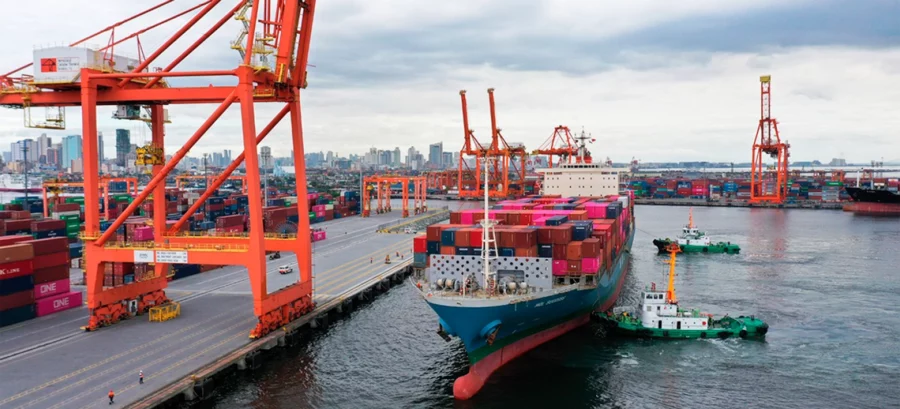
In this context, Portugal adds an Atlantic dimension to the Mediterranean logistics discussion. The Port of Leixões, for example, is positioned as a key infrastructure for Portugal’s competitiveness: it handles around 20% of the country’s maritime foreign trade, receives about 2,400 ships per year and supports exports to 184 countries. For port operators, this is exactly the kind of environment where flexibility becomes a core operating requirement instead of a mere technical advancement.
What changed in Portuguese port logistics in 2024–2025
Recent Portuguese port statistics show how quickly the operating picture can change.
In 2024, mainland Portuguese ports recorded a 6% increase in total cargo handled, reaching 88 million tonnes compared with 82.8 million tonnes in 2023. The year was generally strong for the national port system, reflecting growth across several important cargo segments. But 2025 told a more selective story.
According to AMT, Portugal’s mainland commercial port system handled 82 million tonnes in 2025, down 9.7% compared with 2024. AMT also noted that the system’s performance was significantly influenced by global geopolitical events, exposing not only demand-side vulnerability but also the need for stronger logistics ecosystem resilience under simultaneous shocks.
The container segment also showed different dynamics inside the same system. Total container traffic declined, while transshipment was under stronger pressure than hinterland flows. In the LinkedIn materials prepared for Mediterranean Ports and Logistics 2026, this was framed as an important operational signal: transshipment dropped more sharply than hinterland container traffic, while the cargo structure continued to shift across liquid bulk, Ro-Ro and industrial flows.
This distinction matters, as a port system may decline in total volume, while some cargo flows remain comparatively resilient. For operators, the challenge is not only to process more cargo in good years, but to adapt when the cargo mix changes.
Different ports, different pressure
The Portuguese case is especially useful because the pressure was not distributed evenly across ports.
Sines, the largest port in Portugal, handled 42.1 million tonnes in 2025 and recorded a decline of 16.6%. AMT links this performance to the port’s strong exposure to container transshipment and energy-related liquid bulk flows — segments particularly sensitive to the reorganization of international maritime routes and geopolitical volatility. Leixões, by contrast, handled 14 million tonnes and declined by only 2.5%, with AMT pointing to a mix of local operational factors, including labour stoppages, the implementation of SIMTeM and container-related constraints.
Other ports followed different trajectories again. In the working materials, Lisbon is noted as having grown by 1.9% in 2025, while Aveiro grew by 4.8%, supported by flows more closely connected with industrial and hinterland demand. This proves a crucial role of resilience for port strategy.
Large, globally connected ports may be more exposed to changes in international shipping networks. Ports with mixed cargo profiles and stronger hinterland links may behave differently. Ports serving industrial, agricultural or urban supply chains may face another operating logic altogether.
From a technology perspective, this means that port systems cannot be managed as if all terminals followed the same model. A port authority or terminal operator may need to handle transshipment, gateway cargo, short sea flows, industrial supply chains, Ro-Ro traffic, bulk cargo and breakbulk — sometimes in parallel, sometimes under pressure, and often with shifting priorities.
Why mixed cargo flows make operations harder
Multi-cargo and multimodal operations create complexity at several levels.
First, capacity and flow management become harder. A port handling containers, liquid bulk, solid bulk, Ro-Ro and breakbulk cannot rely on one planning logic. Each cargo type has its own operational rhythm, equipment requirements, documentation flow and yard or terminal constraints.
Second, resource planning becomes more demanding. Berths, yards, gates, rail tracks, trucks, terminal equipment and personnel cannot be managed efficiently in isolation. A delay on one front can quickly affect the next stage of the operation.
Third, transparency becomes critical. When cargo structures shift, terminals need to understand where delays, idle time, bottlenecks and extra moves are actually created. Without this visibility, operational decisions become reactive.
This is why recent shifts in Portuguese port logistics point to a broader industry trend. Along with more capacity, modern ports need better coordination across different operating models.
The role of TOS in flexible port operations
The role of a modern Terminal Operating System evolves from a simple digital registry of cargo and operations to an integral digital layer that connects planning, execution, visibility and data exchange.
For multi-cargo terminals, this is particularly important. Operators need to coordinate vessel, yard, gate, truck and rail activity while managing different types of cargo, different documentation requirements and different service expectations.
Solvo.TOS was designed with this kind of operational complexity in mind. The system supports all major cargo types, including containers, bulk, general cargo, Ro-Ro and vehicles, and is used to automate port and terminal operations across vessel, rail, truck and yard fronts.
The system includes tools for berth planning, cargo planning, rail operations, gate and truck management, yard visibility, KPI monitoring, integration with external systems and digital interaction with terminal customers. It also supports flexible adaptation through applied modules and applications, allowing the system to be configured for different terminal models without losing stability in critical processes.
For ports operating in regions where cargo flows are diverse and market conditions can change quickly, this flexibility becomes strategically important. While supporting current processes, TOS must also help the terminal adapt as trade patterns, cargo structures and customer requirements evolve.
What Portugal’s port dynamics tell us about future competitiveness
Portugal’s port logistics in 2024–2025 show that port competitiveness is becoming more dependent on operational adaptability.
The issue is not only whether a port can handle a high volume of cargo, but also whether it can manage different cargo mixes, transport fronts and planning scenarios inside one connected operating environment. This is especially relevant for regions linked to Atlantic, Mediterranean, European and African trade flows, where ports need to coordinate multiple types of cargo and transport without losing visibility or control.
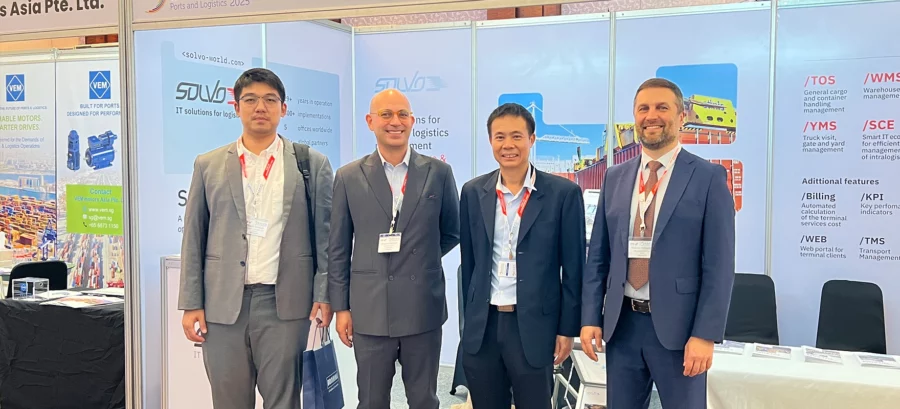
For Solvo, this is why regional discussions around events such as Mediterranean Ports and Logistics 2026 are important. They reflect the real operational questions ports and terminals face today: how to remain efficient under pressure, how to manage changing cargo flows, and how to build digital environments that support both daily operations and long-term resilience.